Nov 10 2009
Memory
Memory is a fascinating area of neuroscience research. It is a classic tale of science in that we are in the middle of putting the pieces to the puzzle together. There are competing theories as to how human memory is constructed, and new research is adding data all the time. I find it particularly interesting because it is an example of the brain trying to understand itself. We all have a brain, we all use our memory, and therefore can relate to this research on a very personal level.
Like much of neuroscience, early knowledge of how memory works comes from dramatic cases of brain injury, from stroke or other causes. With regard to memory a number of cases demonstrated an apparent disconnect between short term memory and long term memory, and so this became the classic view. The most dramatic cases are those of Werkincke-Korsakoff syndrome in which long term nutritional deficits of thiamine, usually in alcoholics, damage the mammillary bodies – small structure in the brain involved in memory. This results in a disconnect between short term memory and long term memory – so patients have about a three minute window of short term memory but form no new long term memories. They are forever living in the past, in a brief window of memory.
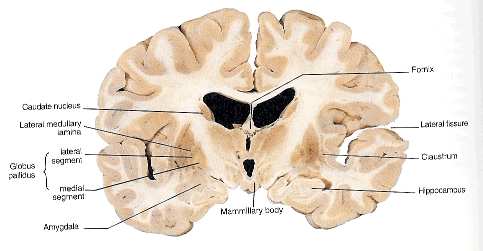 Later research revealed that there is also something called working memory, which is not the same thing as short-term memory, although it is an active question as to how they are related. Essentially scientists are describing how memory works, and then trying to work out the corresponding neuroanatomy. Working memory refers to our ability to hold a few bits of data in our consciousness and manipulate them. Manipulation is the key that distinguishes working memory from mere short-term memory. Neuroscientists are further trying to work out which brain regions are involved in maintaining working memory and which are involved in manipulating working memory.
For example, in order to do math you need to hold numbers in your head and then perform calculation operations on those numbers – that’s working memory. However, if you just hold a phone number in your head for a few minutes until you dial it, that is short term memory.
It is possible that working memory represents a collaboration among various brain systems that include short term memory. Or alternatively, they could be distinct systems in the brain.
A new study explores the relationship between short term memory and long term memory. Again, classically these are separate memory circuits – connected, of course, but distinct. The key structure in the formation of long term memories is the hippocampus – paired brain regions that look like little sea-horses with their curled up tails, hence the name. Damage to the hippocampus impairs long term memory but not short term memory – supporting the notion that these are distinct systems.
However, the new research, looking at patients with damage to both hippocampi due to epilepsy, finds that there is some impairment of short term as well as long term memory. As expected by the classic view, these patients had impaired memory for viewed pictures at 60 minutes (long term memory) but retained memory at 5 seconds (short term memory). However, their memory for details at 5 seconds was impaired – so short term memory was not entirely spared.
This impairment could be due to damage to other structures present in these patients, but assuming this result can be replicated and isolation to the hippocampus confirmed, then it suggests that the different memory systems in the brain, while distinct systems, share anatomical structures.
This view makes a lot of sense, and seems to be the way that neuroscience is heading in general. Increasingly we are understanding brain function as being comprised of networks connecting various modules. Modules are specific brain structures with hard-wiring dedicated to certain types of memory and processing. These modules are involved, however, in multiple networks that carry out specific functions. Therefore, one brain region will tend to be involved with similar types of processes, but may also have different functions when participating in different networks involved in various cognitive tasks.
This is a very complex view of brain anatomy and function that is challenging our classic and simpler view of specific brain regions (modules) having dedicated functions, and the alternate but also simple view of brain networks subsuming specific functions. It increasingly seems that both modules and networks exist.
This creates a complex relationship among the various brain regions and the many specific identifiable cognitive tasks that brains carry out. It is no surprise, therefore, that memory fits into this evolving view of brain function.
What this current research, and other recent research, finds is that short term memory, working memory, and long term memory are all related in that they likely share some structures (modules) but they are distinct networks. They function independently, but are interconnected.
That is a good metaphor for brain function overall – independent modules and networks that are highly interconnected, forming a coherent whole. There may be a multitude of voices constantly chattering in the background, but they combine to form one conscious self.